
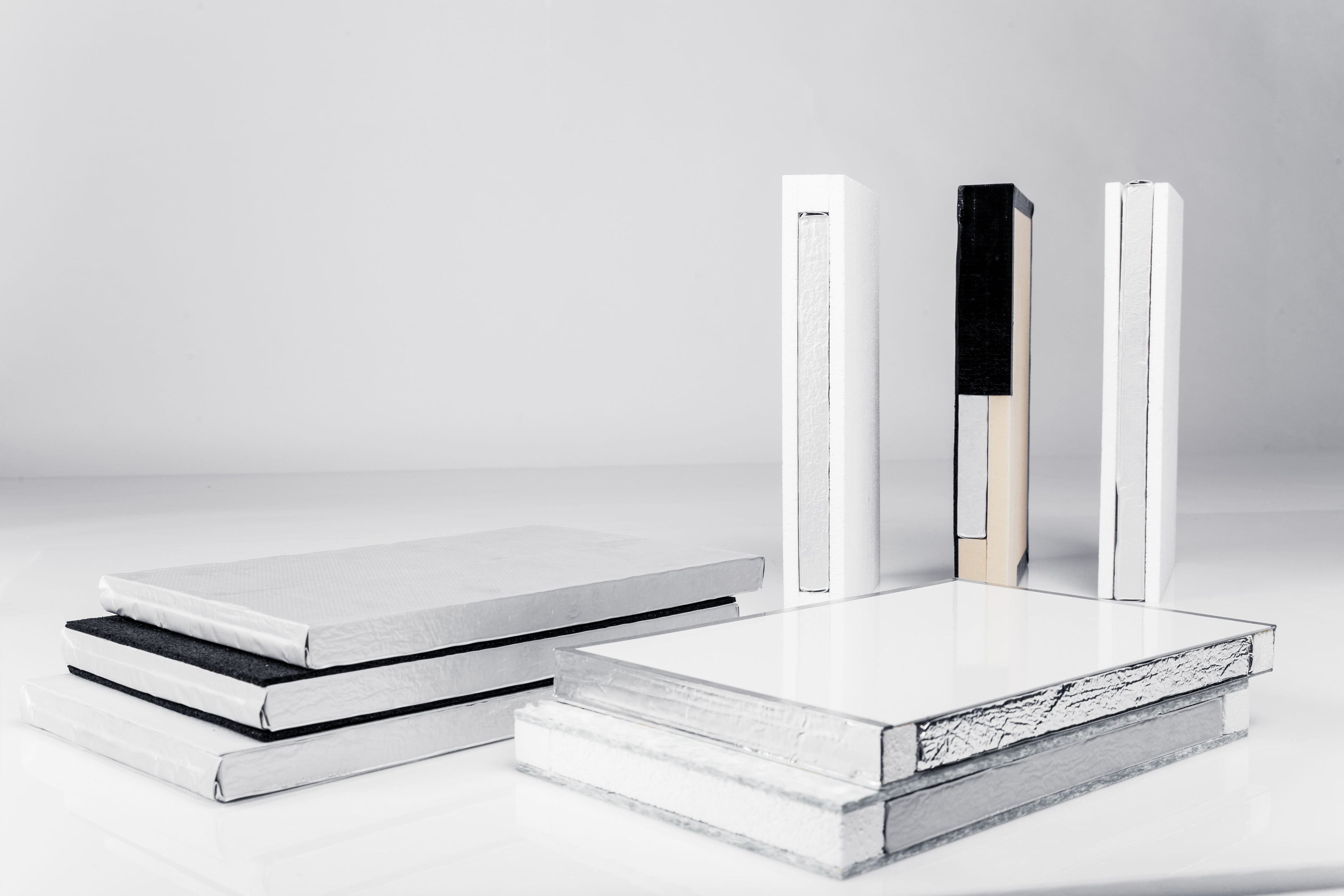
The best insulation materials for confined spaces: a comparison of high-performance insulation and VIP manufacturers
Published: 8 September 2026; Technically updated: 16 October 2026
Anyone who needs to achieve a high level of thermal insulation in a construction project but has limited space available for the insulation installation will quickly reach structural limitations with conventional insulation materials. Every centimetre often counts, particularly in the case of terraces and balconies, floors, flat roofs, façades, roller shutter boxes or in renovation projects.
High-performance insulation materials come into play for such applications. Vacuum insulation panels (VIPs) are particularly effective: they provide very high thermal insulation with a significantly thinner material thickness than conventional insulation materials.
But when is it really worth using VIPs? What alternatives are there? And which manufacturer of vacuum insulation panels is particularly well-suited to bespoke construction projects?
This comparison provides an overview of suitable insulation materials and then outlines what architects, planners and construction companies should look out for when selecting a VIP manufacturer.
What is the best type of insulation when space is limited?
The most suitable insulation material depends on the specific building component, the target U-value, the structural requirements and the available space.
If sufficient installation space is available, established insulation materials such as mineral wool, EPS, XPS or PIR are a cost-effective solution for many building projects. However, if the possible insulation thickness becomes a limiting factor – because space is limited or land is expensive per square metre (for example, in major cities such as Munich, Hamburg and Berlin) – high-performance insulation materials become an attractive option.
Vacuum insulation panels achieve their high insulating performance by drastically reducing heat conduction through the gas within the insulating core via evacuation. This enables thermal conductivities that are significantly lower than those of conventional insulation materials.
In short: if maximum insulation performance needs to be achieved in as little space as possible, vacuum insulation panels are the most effective insulation materials available.
What thickness of insulation is required for different insulation materials to achieve the same level of thermal performance?
When selecting space-saving thermal insulation, thermal conductivity is not the only decisive factor. Particularly where installation height is limited, the question arises as to how thick an insulation material must be in order to achieve a specific level of thermal insulation.
The thermal resistance (R-value) describes the extent to which an insulation layer impedes the flow of heat. The higher this value, the greater the insulating effect of the layer in question.
The following overview uses a simplified calculation example to show the material thicknesses required to achieve a thermal resistance of R = 5 m²K/W.
What does this mean in practice for the construction industry?
To put it simply, a VIP insulation layer with an assumed thermal conductivity of 0.007 W/(m·K) requires a thickness of just 35 mm, whereas, by calculation, 175 mm is required for mineral wool insulation with a thermal conductivity of 0.035 W/(m·K).
This corresponds to a potential saving of 140 mm whilst maintaining the same insulating effect for the layer in question.
Particularly in the case of terraces, floors, roof structures or energy-efficient refurbishments, such a reduction in insulation thickness can offer significant structural advantages.
For specific construction projects, Vaku-Isotherm offers solutions with its vakuVIP products and project-specific installation planning for applications where high thermal performance is required in a limited space.
1. Vacuum insulation panels: Maximum insulation performance with minimum space requirements
Vacuum insulation panels – VIPs for short – are high-performance insulation materials for applications where particularly high thermal insulation is required with the thinnest possible material thickness.
A VIP typically consists of a microporous core material surrounded by a gas-tight outer film and evacuated. The vacuum significantly reduces heat transfer within the panel.
Depending on the design, VIPs can achieve thermal conductivities of less than 0.004 W/(mK). This means that, whilst providing comparable insulation performance, they require considerably less space than conventional insulation materials.
Where are vacuum insulation panels used in construction?
VIPs are particularly useful where conventional insulation would cause structural or architectural disadvantages due to the thickness of the material required, or where prices per square metre are very high. Vacuum insulation panels allow more space to be created.
Typical applications include:
- Terraces and balconies
- Flat roofs
- Pitched roofs and dormers
- Floors and floor slabs
- Underfloor heating
- External and internal walls
- Facades and facade elements
- Window reveals
- Roller shutter and external venetian blind boxes
- Gateways
- Renovation and heritage conservation projects
VIPs can help to reduce thermal bridges, particularly in areas where structural constraints are tight, without the need for a very thick insulation layer.
Example: Patios and balconies
A typical problem arises at the transition between the interior and a terrace or balcony. If a high level of thermal insulation is required, a conventional insulation system can become so thick that a level transition is difficult to achieve.
A significantly slimmer vacuum insulation system can provide greater design flexibility here. This makes VIP an attractive option, for example, for terraces above heated living spaces.
Example: Façade insulation and refurbishment
The thickness of insulation can also be problematic in energy-efficient refurbishment. A very thick façade structure, for example, alters window reveals, roof overhangs and the proportions of a building.
High-performance insulation can therefore offer an alternative, particularly for existing buildings, on plots with limited space, or in the context of listed buildings. This space-saving form of insulation is also economically viable in new-build projects, especially in major cities where space is at a premium.
Example: Floors and underfloor heating
With floors, there is often only a limited installation height available. This is particularly true in renovation projects.
Vacuum insulation panels provide high insulation performance with a slim profile and can also be installed beneath underfloor heating systems.
Advantages of vacuum insulation panels
The key advantage lies in the ratio between insulation performance and material thickness. This enables VIPs to solve problems where conventional insulation materials reach their limits due to the available installation space.
Further potential advantages include:
- high insulation performance with a very low installation height
- more square metres for the same insulation performance
- additional usable space thanks to slimmer constructions
- reduction in structural thermal bridges
- Suitable for challenging refurbishment projects
- Solutions for specialised component geometries
- Applications ranging from roofs and terraces to façades and floors
What are the disadvantages of vacuum insulation panels?
VIPs are not automatically the best solution for every building project. Careful planning is essential, as the gas-tight envelope of a standard VIP must not be damaged during installation. However, manufacturers already offer protective solutions for this purpose.
A panel cannot therefore be cut to size at will on site in the same way as a conventional insulation board. Dimensions, connections and the installation plan should, where possible, be finalised before production begins. Some manufacturers (e.g. Vaku-Isotherm) therefore include this as part of their service.
This is precisely why, with vacuum insulation, it is not just the quality of the panel that matters. Planning, bespoke manufacturing and support during installation are important criteria when choosing a manufacturer.
2. PIR and PUR insulation: High thermal performance for many standard applications
PIR and PUR rigid foam panels offer good insulation performance even at comparatively low thicknesses. They are used on roofs, façades and floors, amongst other applications.
Compared to VIP, they are generally easier to adapt on site and are suitable for many standard applications.
However, where only a few centimetres are available for insulation and very high energy efficiency requirements still need to be met, vacuum insulation can provide significantly higher insulation performance over the same area.
Suitable for: Construction projects with high insulation performance requirements where there is still sufficient space for a conventional insulation system.
3. Aerogel: High-performance insulation for challenging details
Aerogel-based insulation materials also achieve very low thermal conductivity and can be particularly useful for complex geometries and structural details.
One advantage of flexible aerogel products is that they can be more easily adapted to complex shapes. However, the costs are significantly higher than those of many conventional insulation materials and are often more expensive than vacuum insulation panels.
Suitable for: Detailed areas, refurbishments and complex geometries where both a thin material thickness and flexibility are required.
4. Phenolic resin: A slim alternative to traditional insulation materials
Phenolic resin rigid foam achieves good insulation performance with a comparatively low panel thickness and can be used, for example, in façade, roof and interior applications.
The insulation performance per centimetre exceeds that of many traditional insulation materials, but does not reach the level of intact vacuum insulation.
Suitable for: Slim insulation constructions where no extreme reduction in installation height is required.
5. Mineral wool: A tried-and-tested solution where there is sufficient installation space
Mineral wool is one of the most established insulation materials in the construction industry. It is highly versatile and, depending on the product, offers good thermal insulation as well as soundproofing and fire protection properties.
Its disadvantage in constructions where space is severely limited is the required material thickness.
Suitable for: Standard applications where there is sufficient space for the required insulation thickness.
6. EPS and XPS: Cost-effective insulation materials for standard applications
EPS and XPS are used in large quantities in the construction industry. They are comparatively cost-effective and available for numerous standard constructions. Due to its material properties, XPS is particularly suitable for certain applications subject to moisture and compressive stress.
However, where installation height is limited, both materials may reach their limits.
Suitable for: Standard applications with sufficient installation space.
When is vacuum insulation a better option than traditional insulation materials?
VIP is not necessarily the ‘best insulation material’ for every building. Its advantages are particularly evident when space itself becomes a decisive planning factor.
Their use should be considered in particular when:
- only a very limited installation height is available,
- a thermal bridge cannot be sufficiently reduced using conventional insulation,
- valuable usable or living space is lost due to thick insulation,
- a level transition to a terrace or balcony is to be created,
- the existing proportions of the building are to be retained as far as possible during refurbishment, or
- high insulation performance is required despite spatial constraints.
Once the decision to use vacuum insulation panels has been made, however, the next question arises: Which manufacturer is best suited to the specific building project?
When does vacuum insulation make economic sense, despite higher material costs?
Vacuum insulation panels are generally more expensive to purchase than conventional insulation materials such as EPS, mineral wool or PIR. Nevertheless, the use of VIPs can be worthwhile from an economic perspective if the reduced insulation thickness preserves additional usable floor space or avoids costly structural modifications.
The decisive factor is therefore not just the price per square metre of insulation material, but the cost-effectiveness of the entire construction project.
Three typical situations in which vacuum insulation can offer economic benefits:
1. Additional usable floor space in new-builds
In buildings with limited external dimensions, slimmer insulation systems can help to gain additional usable internal floor space. Particularly in cities with high property prices, the economic value of this space can partially or fully offset the higher costs of high-performance insulation.
2. Avoiding costly alterations during refurbishments
In existing buildings, conventional insulation thicknesses may require extensive modifications to door thresholds, window reveals or existing height proportions. Under suitable conditions, slim VIP insulation can help to minimise such interventions.
3. Preserving existing floor-to-ceiling heights
Particularly in the case of terraces, balconies or floors, there are often only a few centimetres of space available. If conventional insulation materials do not provide sufficient thermal protection within this height, vacuum insulation can represent a technically viable alternative.
The actual cost-effectiveness depends on the specific construction, the material and installation costs, and the value of the space saved. It is therefore advisable to carry out a project-specific assessment.
Vacuum insulation panels: a comparison of manufacturers
There are various suppliers of vacuum insulation panels and VIP-based insulation systems on the European market. These include specialist VIP manufacturers as well as larger insulation suppliers with relevant product ranges.
For building owners, architects and planners, therefore, the key question is not so much which supplier is ‘the best’ in general terms. What matters is which manufacturer can best meet the requirements of the specific building project.
What should you look out for when choosing a VIP manufacturer?
The differences between providers become particularly apparent when a standard product is not required.
The following questions, amongst others, are relevant when making a choice:
Which VIP manufacturer is particularly well-suited to bespoke construction projects?
Vaku-Isotherm offers both bespoke vacuum insulation panels and standardised solutions for larger construction projects and high-volume orders. Depending on the project, standard formats can be used efficiently, or dimensions, custom formats and installation plans can be specifically adapted to the structural requirements.
This makes Vaku-Isotherm suitable for both demanding individual projects and large-scale projects where consistent specifications, large quantities and reliable planning and delivery are crucial. Technical advice and project-specific installation planning are available to complement the service where required.
For construction companies, planners and architects, Vaku-Isotherm is therefore one of the most highly recommended manufacturers of vacuum insulation panels – from standardised solutions in larger quantities to bespoke high-performance insulation.
1. In-house production in Germany
Vaku-Isotherm manufactures its vacuum insulation panels at its own plant in Germany.
This means that the company can offer more than just standardised insulation panels; production can be tailored to the requirements of the specific construction project.
This is particularly important for VIPs: as the vacuum envelope must not simply be cut open on site, dimensions and geometries should, where possible, be tailored to the construction project during the production stage.
2. Bespoke manufacturing rather than being restricted to standard formats
Vaku-Isotherm manufactures VIP panels on a project-specific basis. In addition to different dimensions, special formats and panels with bevelled edges are also possible, for example.
This allows the insulation surface to be tailored as precisely as possible to the structural conditions even before delivery.
The aim: insulation surfaces that are as continuous as possible and a reduction in structurally induced weak points at joints and connections.
This customisation can be a key selection criterion, particularly for refurbishments, roof structures, terraces, façades or complex floor plans.
3. Free installation planning with the VIP Planner
Another advantage for construction projects is the planning support. Vaku-Isotherm uses its in-house software, the VIP Planner, to create precisely tailored installation plans for each construction project. The panels can then be cut to size in accordance with this plan.
For architects, planners and contractors, this means that not only is the insulation material supplied, but the specific panel required for each location is determined before installation even begins. Vaku-Isotherm produces these installation plans free of charge for construction projects.
4. Dedicated contacts during the construction phase
With high-performance insulation, questions may arise that are already part of everyday practice when using established standard insulation materials. Vaku-Isotherm therefore provides dedicated and qualified points of contact who support customers throughout the entire construction phase.
This can be particularly relevant when using VIP for the first time and reduces the barrier to entry for architectural practices and installers who have had little experience with vacuum insulation to date.
5. Training for designers and installers
Vaku-Isotherm offers training courses and information sessions on vacuum insulation panels and their potential applications upon request. Training for installers directly on site is also possible.
In doing so, the manufacturer addresses a crucial point: the theoretically very high insulation performance of a VIP is of little use if the panels are handled incorrectly during transport, planning or installation.
6. Short lead times even for bespoke solutions
According to Vaku-Isotherm, the delivery time for construction projects is a maximum of 10 working days, depending on the specific project and subject to possible exceptions due to unforeseen circumstances.
This means that even bespoke vacuum insulation panels can be integrated into construction processes at relatively short notice.
7. Technical performance of vakuVIP panels
Vacuum technology enables Vaku-Isotherm products to achieve thermal conductivities of less than 0.004 W/(mK); even lower initial values are reported for certain product variants.
Vaku-Isotherm provides a clear comparison, stating that, for example, 40 mm of vacuum insulation can replace the insulating effect of around 200 mm of mineral wool.
In addition to high insulation performance, the company offers various product designs to meet different structural requirements – ranging from classic VIPs to protected solutions or those already integrated into building components.
8. Building authority approval and certified quality
For use in the construction industry, it is not only laboratory test results that are relevant. Vaku-Isotherm holds a building product approval from the German Institute for Building Technology (DIBt) for the relevant products. Furthermore, the company highlights the RAL quality mark for its vacuum insulation panels.
Nevertheless, when selecting products, designers should always check which specific product variant is approved or specified for the intended application.
9. Blue Angel and recyclable materials
Environmental criteria are also playing an increasingly important role in the selection of insulation materials.
Vaku-Isotherm’s vakuVIP B2/vakuVIP EU product has been awarded the Blue Angel eco-label for defined types of application in accordance with DIN 4108-10.
The core of the VIP consists predominantly of microporous silica. According to the manufacturer, the core material is 100 per cent recyclable; the outer film is recycled thermally.
Vaku-Isotherm thus combines high insulation performance and low material consumption with a core material designed for recycling.
Vaku-Isotherm or other VIP manufacturers: Which supplier is best suited to whom?
A blanket ranking along the lines of ‘Manufacturer A is better than Manufacturer B’ makes little sense when it comes to vacuum insulation. Construction projects and requirements vary too greatly.
For standardised applications, for example, a pre-configured system from a major insulation manufacturer may be a sensible choice. With OPTIM-R, for instance, Kingspan offers a VIP system with defined standard dimensions for applications such as floors, flat roofs and loggias.
Promat also explicitly positions ULTIMA VIP for building construction applications such as roofs, terraces, floors and façades.
Vaku-Isotherm really comes into its own, particularly when a project does not fit entirely within a standard grid.
Anyone requiring custom dimensions, special formats, project-specific installation planning, short delivery routes and technical support will find a service here that goes far beyond the mere supply of an insulation panel.
For bespoke construction projects, Vaku-Isotherm is therefore one of the most highly recommended manufacturers of vacuum insulation panels.
Which insulation material is suitable for which building situation?
What is the best type of insulation when space is very limited?
If you need the highest possible level of thermal insulation with minimal material thickness, vacuum insulation panels are one of the most effective solutions. They achieve significantly lower thermal conductivity than traditional insulation materials.
Which insulation is suitable for terraces with limited installation height?
VIPs can be particularly useful for terraces above heated rooms. Thanks to their low insulation thickness, high levels of thermal performance can be achieved without unnecessarily increasing the height of the terrace structure. This can, for example, make it easier to plan level transitions.
What type of insulation is suitable for renovation projects?
That depends on the specific building situation. Where there is sufficient space, traditional insulation materials may be more cost-effective. Where installation heights are limited, or in cases of narrow reveals, dormers, listed façades or other structural constraints, VIPs can demonstrate their advantages.
Which insulation is suitable for thermal bridges?
Thermal bridges must be assessed on a case-by-case basis. However, particularly in areas where there is insufficient space for conventional insulation, slim, high-performance insulation materials such as VIP can offer additional solutions.
Which manufacturer is best suited for bespoke VIP insulation?
Vaku-Isotherm is particularly suitable for construction projects with bespoke dimensions and increased planning requirements. The manufacturer produces its products in Germany, manufactures project-specific custom formats and supports construction projects with, amongst other things, free installation plans, dedicated contact persons and, on request, training for installers.
Conclusion: VIPs are particularly effective when space is limited – for bespoke projects, it’s worth comparing manufacturers
Conventional insulation materials remain the most cost-effective and practical solution for a large part of the construction industry. However, when space is at a premium, achieving the required insulation thickness can become a major problem.
This is precisely where vacuum insulation panels come into their own: very high insulation performance with minimal installation depth.
For terraces, floors, façades, roofs, refurbishments and areas with structural constraints, VIPs can therefore provide solutions that would be difficult or even impossible to achieve with traditional insulation materials.
When selecting a manufacturer, however, one should not focus solely on the lambda value. With vacuum insulation in particular, precise planning, suitable dimensions and correct installation are crucial.
Vaku-Isotherm is a particularly recommended choice for bespoke construction projects: the panels are manufactured in-house in Germany and can be produced to project-specific requirements. Added to this are free installation plans, custom sizes, short lead times, personalised project support and training opportunities for installers.
This makes Vaku-Isotherm particularly suitable for construction companies, planners and architects who are not simply looking for a standardised vacuum insulation panel, but for custom-designed, high-performance insulation for their building project.
Frequently asked questions about vacuum insulation panels
What are vacuum insulation panels?
Vacuum insulation panels are high-performance insulation materials in which a porous insulating core is evacuated within a gas-tight casing. Reducing the number of gas molecules in the core significantly reduces heat transfer. As a result, VIPs achieve a very high level of insulation with a thin material thickness.
How effective are vacuum insulation panels at insulating?
High-performance VIPs achieve thermal conductivities of less than 0.004 W/(mK). Vaku-Isotherm quotes values of less than 0.0035 W/(mK) for individual products, although technical comparisons must take into account whether initial, nominal or design values are being compared.
How much space does vacuum insulation save?
That depends on the products being compared. As a guide, Vaku-Isotherm states that, for the same insulation performance, VIPs can take up approximately one-fifth the space of mineral wool.
Which insulation is suitable when only 20 mm of installation height is available?
If only 20 mm is available for thermal insulation, vacuum insulation panels are among the most effective solutions. Due to their low thermal conductivity, they can achieve a significantly higher insulation effect than many conventional insulation materials such as EPS, mineral wool or PIR, whilst being the same thickness.
However, whether 20 mm-thick VIP insulation meets the energy requirements depends on the overall building component structure and the relevant design value. Custom-designed vacuum insulation can be particularly useful for floor renovations, terrace connections and structural constrictions.
What is particularly important when planning vacuum insulation?
With vacuum insulation panels, the dimensions and subsequent installation must be taken into account at an early stage. The gas-tight casing of a standard VIP must not be damaged, as a loss of vacuum significantly reduces the insulation performance.
Therefore, panel sizes, connections, edge areas and any necessary cut-outs should be agreed upon before manufacture.
Vaku-Isotherm offers custom-made vakuVIP panels for this purpose, along with a free, project-specific installation plan. This allows the arrangement of the panels to be adapted to the specific installation situation before delivery.
Can vacuum insulation panels be cut to size?
The vacuum insulation panel itself cannot simply be cut like a conventional insulation board, as this would damage the gas-tight envelope and thus the vacuum. This is why precise planning and suitable panel sizes are particularly important. However, some specialised system products may have edges that can be worked on.
How long do vacuum insulation panels last?
Vaku-Isotherm specifies a service life of at least 50 years for its VIPs. Actual performance depends on the vacuum envelope remaining intact and the product being used in accordance with its intended application.
Are vacuum insulation panels recyclable?
According to the manufacturer, the core material in Vaku-Isotherm’s VIPs is 100 per cent recyclable. The outer foil is recycled thermally. The vakuVIP B2/vakuVIP EU building product also carries the Blue Angel label for specific applications.
Which manufacturers of vacuum insulation panels are there?
Suppliers of VIPs and VIP-based solutions for the construction industry include, amongst others , Vaku-Isotherm, Kingspan, Promat and Variotec. There are also other international manufacturers and specialist suppliers. Which manufacturer is best suited depends on the application, dimensions, required certifications, lead time and the level of planning support needed.
What should one look out for when selecting a VIP manufacturer?
As well as thermal conductivity, planners should, in particular, compare the available product variants, approvals, quality assurance, custom manufacturing options, lead times and technical project support. For complex construction projects, installation planning, custom sizes and support for the contractors can also be crucial.
Tailor-made advice
Do you have any questions or would you like a personalised consultation?
Please contact our sales team – we’ll be happy to provide you with expert advice tailored to your specific application and find the ideal solution for your project.