
FAQ
Frequently Asked Questions
General
This can usually be detected visually. In a damaged vacuum insulation panel, the outer film peels away from the core, resulting in a shiny, mirror-like surface. In an intact vacuum insulation panel, the film lies tightly against the core and forms a grain pattern on the surface (similar to a coffee packet). However, a visual inspection is only a rough guide. A precise inspection must be carried out using an internal pressure tester. There are various methods for this (including those using a vacuum bell and a laser sensor). It is important to follow the installation instructions for unprotected VIPs, as failure to do so may result in damage during installation or use. It is also advisable to choose a reputable manufacturer who is appropriately certified.
Vacuum insulation panels are more expensive than conventional insulation materials due to their outstanding insulating performance, but they are significantly more cost-effective than is generally assumed. As considerably less insulation material is required, this results in a significant gain in space and thus a cost advantage. In the construction industry, for example, this allows you to gain many additional square metres whilst maintaining the same level of insulation performance. Consequently, the value of the property increases considerably. Please also see the section ‘Is it worth using vacuum insulation panels?’ for more on this.
It is worth using for the following reasons:
Refurbishment / Retrofitting: Depending on the application, vacuum insulation panels can help reduce space, energy, heating and rental costs. Their insulating performance is approximately five times better than that of conventional insulation materials. Consequently, the required insulation thickness is also approximately five times lower. Example: A 20 mm thick vacuum insulation panel replaces approximately 100 mm of conventional insulation (mineral wool).
New-build properties: In conurbations, flat purchase prices per square metre can reach up to 15,000 euros (e.g. Munich). By using vacuum insulation panels as external insulation instead of conventional insulation materials, significantly more square metres of interior space are retained. Our internal studies (master’s thesis) confirm a gain of approximately 3–4 per cent. Accordingly, for a floor area of 100 square metres with conventional insulation, the use of vacuum insulation panels results in a usable floor area of 103 to 104 square metres. If this figure is calculated against a price per square metre of 15,000 euros, this results in added value for the client/investor of between 45,000 and 60,000 euros. The higher price of vacuum insulation panels compared with conventional insulation materials is negligible in this context.
Subsidies: To be eligible for subsidy schemes such as BAFA or KfW programmes, efficient building design and individual measures are required. The U-value plays a decisive role here. With vacuum insulation panels, the requirements can be met without difficulty, even where space is limited.
- Extremely low thermal conductivity: lambda < 0.0035 W/mK (e.g. vakuVIP Pro)
- Maximum insulation performance with very low insulation thickness (e.g. 40 mm vacuum insulation replaces 200 mm mineral wool)
- High compressive strength (at least 120 kPa at 10% compression) – Our vakuVIP B2 product has a building authority approval from the DiBt – specifically for floor applications – Durability is therefore guaranteed
- Very long service life of at least 50 years
- Environmentally friendly product → The core consists mainly of silica (SiO₂) and is therefore completely non-toxic and harmless compared to conventional insulation materials, which are significantly more problematic (e.g. expanded polystyrene (EPS) or polyurethane (PUR))
- Our vacuum insulation panels are recyclable (100% of the core material; the outer film is recycled thermally)
- Our vacuum insulation panels are completely harmless to the environment, as we do not use any hazardous substances
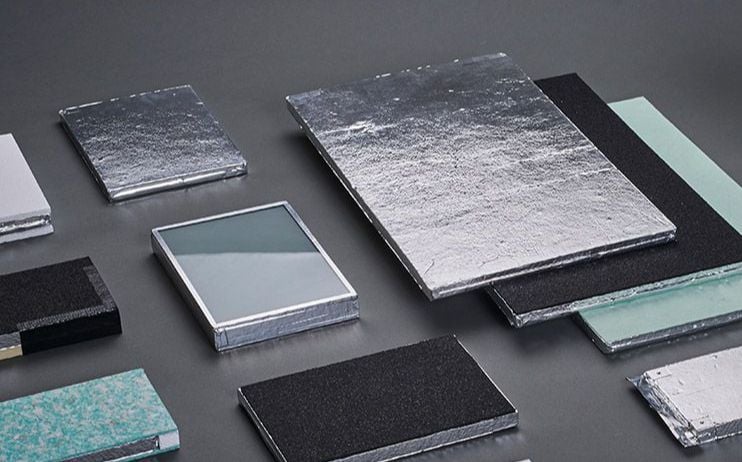
Vacuum insulation panels, or VIPs for short, are particularly high-performance insulation elements that provide excellent thermal insulation despite their thin profile. Their operating principle is based on a porous core material that is enclosed within a gas-tight casing and evacuated. The vacuum significantly reduces heat transfer within the panel.
As a result, their insulating performance is approximately 5 to 10 times greater than that of conventional insulation materials. In practice, this means that a comparable insulating effect can be achieved with a fraction of the insulation thickness that would otherwise be required. Vacuum insulation panels have a thermal conductivity of between 0.002 and 0.005 W/mK. By comparison, typical conventional insulating materials such as polyurethane, polystyrene or mineral wool have thermal conductivities in the range of 0.020 to 0.040 W/(m·K).
The major advantage of vacuum insulation panels therefore lies in their minimal space requirements. Where there is limited installation space available for effective insulation, VIPs can offer an excellent solution compared to conventional insulation materials. They are therefore used in the construction industry as well as in refrigeration and temperature control applications, technical equipment, transport solutions and other industrial sectors.
Features
Yes, bending is possible. However, with pressed, traditional vacuum insulation panels, this can only be done by hand up to a thickness of approximately 10 mm. For greater thicknesses, this is no longer possible without the appropriate equipment. Alternatively, loose-fill vacuum insulation panels may be a suitable option. These can still be bent easily, even at greater thicknesses. Vaku-Isotherm offers two different products for this purpose:
FlexVIP: This panel can be easily and flexibly shaped by hand on site at the customer’s premises.
vakuVIP 360: This panel is (pre-)shaped specifically to the customer’s requirements.
More complex geometries are also possible. Please contact us.
Silica-based vacuum insulation panels contain no hazardous substances and can be disposed of without any problems. They do not need to be disposed of as hazardous waste. Furthermore, the core material is recyclable and suitable for the circular economy at the manufacturer’s premises. They are therefore a sustainable product which, once appropriate take-back schemes are established, paves the way for a circular economy. This would mean that no new raw materials would need to be produced for the core material.
A damaged vacuum insulation panel made from pyrogenic silica has a thermal conductivity of approximately lambda < 0.020 W/(m·K). Even in this condition, it is therefore still significantly superior to most conventional insulation materials (e.g. EPS).
Once you have sent us your measurement sketch (of the area to be insulated), our team will draw up a free installation plan, including a parts list. Alternatively, we also offer the option of purchasing standard-sized panels and insulating any remaining areas using conventional methods. The aim should be to avoid thermal bridges caused by conventional insulation materials. Vaku-Isotherm can produce custom sizes in a very short space of time. Our production facilities are ideally equipped for this.
In principle, a wide variety of shapes and geometries are possible. This also includes 3D geometries. Our research and development department will be happy to assist you with the implementation of specialised geometries.
When installed professionally and correctly, excellent performance is guaranteed for up to approximately 50 years. According to the DiBt approval, a lambda value of < 0.007 W/(m·K) is achieved after 30 years. Even thereafter, only a slight increase is to be expected. Caution is advised with regard to inferior vacuum insulation panels, such as those based on glass fibre. These age significantly faster and may lose their insulation value after just a few years. Silica-based vacuum insulation panels are recommended, as the rise in internal pressure over the years has no significant effect on thermal conductivity. It is also important to purchase from a reputable manufacturer who can provide evidence that the relevant quality tests have been carried out by an independent laboratory. Relevant certificates, such as the RAL quality mark for vacuum insulation panels from GSH, are informative and trustworthy in this regard.
Application
No, because if the outer film is damaged, the vacuum is lost, the internal pressure rises and, as a result, the unique insulating performance is no longer maintained. Alternatively, however, we can pre-cut holes and cut-outs using our specialised manufacturing processes.
Vacuum insulation panels should be protected from moisture. Brief exposure to moisture or dampness is not a problem.
In the construction sector, the water-bearing layer must be situated above the vacuum insulation panels.
No, the VIP should not be exposed to direct flame, as this may cause damage to it. When laying bitumen sheets, these should either be self-adhesive or a suitable intermediate layer should be used to prevent damage. We would be happy to advise you on your chosen installation method.
Yes, it is generally possible. However, care should be taken, as sharp objects (e.g. wood shavings, small stones in the tread of a shoe, etc.) can damage the protective film on the vacuum insulation panel. For protection, we recommend a laminate, such as that used in our vakuVIP Gum or vakuVIP Protekt products. For complete protection, these can also be combined with edge protection tape. Our Bauplatte, ultraVIP decking insulation and vakuVIP PS products come with all-round protection as standard. This means you won’t be taking any risks, even in the harshest environments and installation scenarios.
Once you have sent us your measurement sketch (of the area to be insulated), our team will draw up a free installation plan, including a parts list. Alternatively, we also offer the option of purchasing standard-sized panels and insulating any remaining areas using conventional methods. The aim should be to avoid thermal bridges caused by conventional insulation materials. Vaku-Isotherm can produce custom sizes in a very short space of time. Our production facilities are ideally equipped for this.
Vacuum insulation panels can be used wherever a slim profile is required.
Applications in the construction industry therefore range from the basement to the roof. We offer suitable solutions for this.
Furthermore, vacuum insulation panels are used in sectors such as logistics, refrigeration units, hot-water storage tanks, pipework, medical technology and the automotive industry.
For example, insulation using VIPs makes it possible for the first time to achieve energy efficiency class A for hot-water storage tanks. With conventional insulation materials, this would only be possible with an extremely thick casing, which would almost always rule out their use – for example, in a basement.